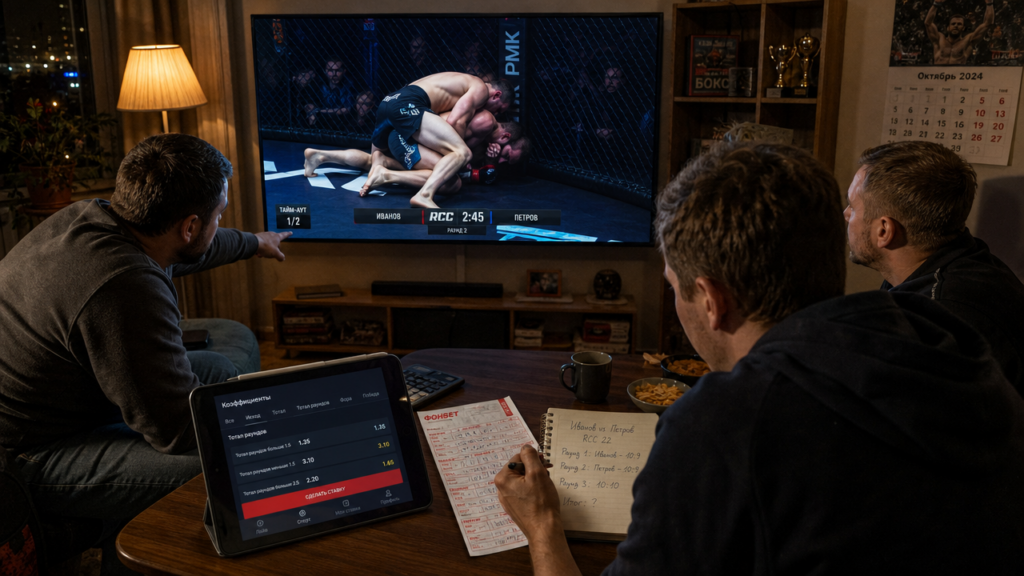
MMA fight betting settles on the official result: knockout, TKO, submission, decision, or draw. A three-round bout moneyline of -150 reflects a 60 percent implied probability, so the bettor needs that fighter to win more than 60 percent of the time to break even. MMA sports betting rewards a closer read through style mechanics and round-level props, where a narrow settlement condition can offer a better price than the raw favorite.
Moneyline, Implied Probability, and Style Interaction
Start with the output that determines the fight script. If Fighter A lands 5.8 significant strikes per minute while Fighter B absorbs 4.9 per minute against pressure boxers, the strike differential points to a decision or late TKO. If Fighter B also threatens with submissions at a high rate, that submission threat can force the favorite to avoid the mat and slow the pace. The bet is not automatically Fighter A; it can be the over 2.5 rounds at a better price when both finishing rates stay below 25 percent. Cage cutting matters here because a fighter who cannot cut the cage will struggle to maintain that striking edge and may allow the underdog to circle away.
Takedown defense changes the moneyline calculation. An opponent defending 91 percent of takedown attempts turns 10 attempts into an expected 0.9 successful takedowns. That makes a wrestler-priced favorite less valuable on the moneyline, while the total takedowns under becomes a stronger position. Clinch control is the bridge between cage cutting and takedown offense: a fighter who wins underhooks and head position against the fence can force ground exchanges, but only if the opponent cannot separate.
Total Rounds and Takedown Props: How Settlements Work
In a three-round fight, one full round is 5 minutes, so 1.5 rounds equals 7 minutes and 30 seconds of fight time. Over 1.5 rounds wins only if the bout goes past that threshold; under 1.5 wins if the finish occurs before the 2:30 mark of round 2. The Yandiev vs Johnson finish at 0:02 of round 2 settled under 1.5 because the total time was 5 minutes and 2 seconds. A bettor who wanted over 1.5 needed the fight to enter the second half of round 2. Title fights run five rounds, so the 2.5-round line moves to 12 minutes and 30 seconds, and the 3.5-round line moves to 17 minutes and 30 seconds.
Total takedowns is a separate market on successful ground transitions from standing position. Over 1.5 requires two or more takedowns with control; Under 1.5 settles with zero or one. A slam that loses top position immediately may not count if there is no control time, which is why scramble-heavy fighters can keep the under live even against wrestlers. Fractional totals settle as a win or loss only, with no refunds at the half marker.
| Market | Settlement condition | Key analytical input | Typical use |
|---|---|---|---|
| Moneyline | KO/TKO, submission, decision, or draw | Implied probability vs. style projection | Baseline position |
| Total rounds over/under 1.5 | Over needs to pass 7:30 total in a three-round bout; under needs a finish before 2:30 of round 2 | Finishing rate, pace, cardio | Main card total |
| Total takedowns over/under 1.5 | Over needs 2 or more controlled takedowns; under settles with 0-1 | Takedown average, opponent takedown defense | Wrestler matchup |
| Method of victory | KO/TKO, submission, decision | Strike differential, clinch control, submission threat | Exotic prop |
| Round group | Win in rounds 1-2, round 3, rounds 4-5, or decision | Early finisher record, championship rounds | Card assembly |
The table shows that moneyline is only the anchor. A wrestler with poor striking may have a -170 moneyline, but if the opponent defends 92 percent of takedowns, the better position may be the striker at +130 or under 1.5 total takedowns at -120.
Round-by-Round Card Analysis: Building a Card Edge
Round-by-round card analysis assigns each bout a most likely route and round before checking prices. For a five-round title fight, 2.5 rounds equals 12 minutes and 30 seconds; the over requires the fight to pass the midpoint of round 3. Two decision-heavy fighters with takedown defense above 80 percent push that over. A pressure wrestler with multiple first-round finishes pushes the under regardless of opponent toughness. Early finishers such as Khamzat Chimaev can shift round 1 and under 1.5 props because their wrestling pressure produces stoppages before volume strikers can establish range.
Check schedules and quick turnarounds. A six-week return after a 25-minute fight can flatten a pressure fighter by round 3, which supports the underdog in round group betting or over 1.5 rounds if the favorite’s pace drops. Draw props exist, but the settlement requires an official draw, which is far less frequent than the price implies in most MMA organizations.
A practical structure is to split a unit across a round total and a method prop. One example is 0.75 units on under 3.5 rounds at -115 and 0.25 units on Fighter A by knockout in rounds 1-2 at +260. The under remains live if the favorite cannot force a finish, because the opponent’s reactive wrestling often produces back takes and late submission sequences. MMA fight betting becomes more disciplined when you stop betting moneyline only and start pricing the outcome through route.